


Psyllium Husk and Cholesterol: The Conversation Happening in Clinics Across the USA and Canada
April 11, 2026
Your Doctor Is Already Recommending It. Your Supplier Should Be Ready.
Something shifted in how American and Canadian cardiologists talk about dietary fiber around five years ago. The conversation stopped being about general wellness and started being about specific clinical outcomes. Psyllium husk moved from the shelves of health food stores into the conversations happening between physicians and patients who were trying to manage their LDL cholesterol without immediately jumping to statins.
This is not a trend. It is a sustained clinical behaviour change backed by something quite rare in the supplement world: a formal health claim approved by the US Food and Drug Administration. Since 1998, the FDA has allowed food and supplement products containing psyllium soluble fiber to carry a qualified health claim linking their use to reduced risk of coronary heart disease. That approval is not given easily and it carries real commercial weight.
For supplement brands and health product manufacturers serving the US, Canadian, and South Korean markets, the cholesterol angle is one of the most substantiated and commercially valuable positions available in the psyllium category. But it requires sourcing psyllium that genuinely supports that positioning. This blog explains the science, the market opportunity, and what responsible sourcing looks like for this specific application.
1. What the Science Actually Says About Psyllium and Cholesterol
The mechanism is well understood and it has been replicated across dozens of clinical studies. Psyllium husk contains a high concentration of soluble fiber that, when consumed with water, forms a thick viscous gel in the digestive tract. That gel binds to bile acids in the intestine. Bile acids are made from cholesterol, and when they bind to psyllium fiber they are excreted rather than reabsorbed. The liver responds by pulling more cholesterol from the bloodstream to produce replacement bile acids. The net result is a measurable reduction in circulating LDL cholesterol.
The clinical literature is consistent in showing that regular psyllium supplementation, typically 10 to 12 grams per day taken with meals, produces a meaningful reduction in LDL cholesterol over a period of weeks to months. The effect is not dramatic in the way that statin drugs are, but for patients who are mildly elevated and not yet at a level where medication is the obvious first step, psyllium represents a safe, well tolerated, and clinically supported option.
What makes this particularly interesting for supplement brands is that the FDA approved health claim exists, the clinical evidence base is robust enough to satisfy regulatory scrutiny in Canada and South Korea as well, and the consumer demand for natural cholesterol management options has been growing steadily as more people look for alternatives or complements to pharmaceutical intervention.
Key Points That Supplement Brands Should Know About the Evidence Base
- Multiple randomised controlled trials over the past thirty years consistently show LDL cholesterol reductions in the range of 5% to 10% with regular psyllium use at recommended doses
- The FDA qualified health claim requires that a product contain at least 1.7 grams of psyllium soluble fiber per serving to make the cholesterol related claim, which translates to approximately 7 grams of whole psyllium husk at 98% purity
- Health Canada recognises dietary fiber claims for psyllium under its Natural Health Products regulations, making it one of the few ingredients where parallel health claims can be made across the US and Canadian markets simultaneously
- South Korea’s Ministry of Food and Drug Safety has its own functional food claim framework that accommodates fiber related cholesterol benefits, making psyllium a relevant ingredient for Korean health food manufacturers as well
2. How the US and Canadian Supplement Markets Are Responding
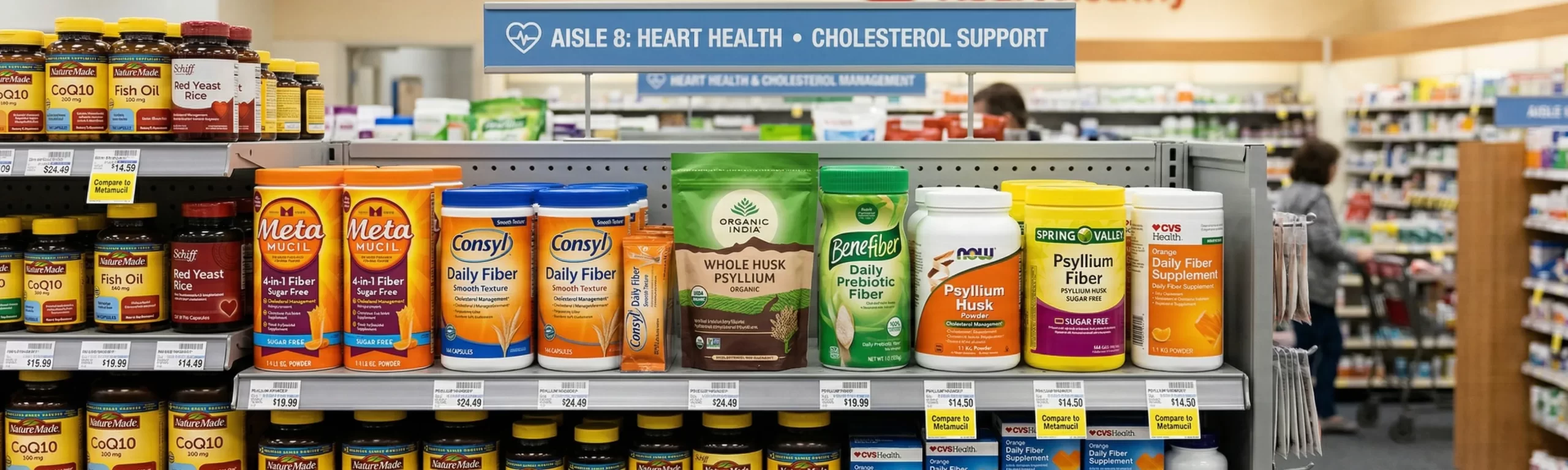
Walk into a Costco, a CVS, or a Canadian pharmacy chain and you will find psyllium husk products sitting squarely in the heart health section alongside omega 3 fish oils and plant sterols. The positioning shift from laxative aisle to heart health section happened quietly but it has had a real commercial effect. Consumers who previously would not have considered buying a fiber supplement are now picking up psyllium products because their doctor mentioned it at a routine check-up.
This physician to consumer pipeline is one of the things that makes the cholesterol angle particularly valuable for supplement brands. Customers who come through a clinical recommendation tend to be more loyal and more consistent in their purchasing than those who discover a product through advertising. They have a specific health goal, they have been told by someone they trust that this ingredient supports that goal, and they are looking for a product they can rely on.
For brands serving this customer profile, product quality is not negotiable. A customer who is supplementing for cardiovascular health is not casually buying a wellness product. They are managing a health concern. If the psyllium in their supplement is inconsistent in purity, or if the swelling factor is lower than it should be, the therapeutic effect is reduced and the customer notices. This is why brands in this category tend to source at 98% or 99% purity and why they stay with suppliers who can demonstrate batch-to-batch consistency over time.
What Brands in the Heart Health Category Look for from Their Psyllium Supplier
- Confirmed 99% or 98% purity with full USP 29 test data including swelling factor, which directly affects the fiber’s cholesterol binding efficacy
- Microbiological testing results that satisfy FDA and Health Canada requirements for supplement grade ingredients
- Allergen declaration and heavy metal testing documentation, both of which are increasingly expected by US and Canadian supplement retailers as standard incoming quality requirements
- Stable supply across the year since heart health supplement brands run continuous production and cannot absorb supply disruptions without affecting their customers
3. What South Korean Brands Are Doing Differently
South Korea has its own approach to the psyllium and cholesterol story and it is worth understanding if you are sourcing for that market or thinking about entering it.
Korean supplement brands are meticulous about ingredient sourcing documentation in a way that sometimes surprises first-time exporters to that market. A Korean buyer will not just ask for a Certificate of Analysis. They will ask for the accreditation status of the testing laboratory, the test method references for each parameter, and sometimes a second COA from an independent laboratory to corroborate the supplier’s in house results. That is not scepticism for its own sake. It reflects a regulatory environment where Korean functional food health claims require a documented evidence trail that goes all the way back to the raw ingredient source.
Korean brands positioning psyllium products for cholesterol support typically source at 98% purity or above, they favour psyllium husk powder over whole husk for the formulation flexibility it offers, and they tend to build longer-term supply relationships once they have found a manufacturer they trust. The onboarding process can take longer than in the US or Canadian market, but the relationships tend to be more stable once established.
4. Why Psyllium Purity Directly Affects the Cholesterol Claim
This is a point that does not get discussed clearly enough in the supply chain conversation. The cholesterol benefit of psyllium is directly tied to the mucilage content of the fiber, which is expressed through the swelling factor measurement. Higher purity psyllium has more intact husk, higher mucilage content per gram, and a higher swelling factor. Lower purity grades have more seed coat fragments and filler material, which means less active soluble fiber per gram and a weaker therapeutic effect per serving.
If a supplement brand is making a label claim about cholesterol support and they are sourcing at 90% purity to save money, they face a real problem. Their serving size calculations may be based on a higher purity specification, which means the amount of active soluble fiber the customer is actually consuming per dose is lower than what their label implies. In the US market, that kind of discrepancy is the sort of thing that attracts regulatory attention.
We are direct with buyers about this at Prime Psyllium. If you tell us you are formulating a cholesterol support product for the US or Canadian market with an FDA health claim on the label, we will recommend 98% or 99% grade and explain why. The per kilogram price difference is small relative to the risk of building a product on a specification that does not properly support the claim you are making.
5. Sourcing Psyllium for the Heart Health Category: How to Start
If you are a supplement brand entering the cholesterol management space, or an existing brand looking to improve the quality of your psyllium source, the conversation starts with your formulation requirements. What purity grade does your product specification require? What serving size are you using and does it deliver the minimum soluble fiber content needed to support your health claim? What documentation does your regulatory team need from the raw ingredient supplier?
We supply psyllium at 98% and 99% purity to health brands in the USA, Canada, and South Korea from our facility in Palanpur, Gujarat. Every batch is tested in our in house laboratory with results verified against USP 29 standards. Full documentation including Certificate of Analysis, Certificate of Origin, Phytosanitary Certificate, and MSDS is prepared for every shipment. Samples are available for dispatch within five business days.
If you are ready to have a specific conversation about your sourcing requirements, reach out through our website or by email. We are straightforward to work with and we would rather spend time answering your questions properly than closing a sale quickly.
Ready to Source the World’s Finest Psyllium?
Quality • Purity • Global Reach
www.primepsyllium.com | [email protected]
Prime Psyllium — India’s Trusted Psyllium Manufacturer and Global Exporter
