

From a Farm in Gujarat to a Shelf in Moscow: How Psyllium Husk Travels and Why the Journey Matters
April 11, 2026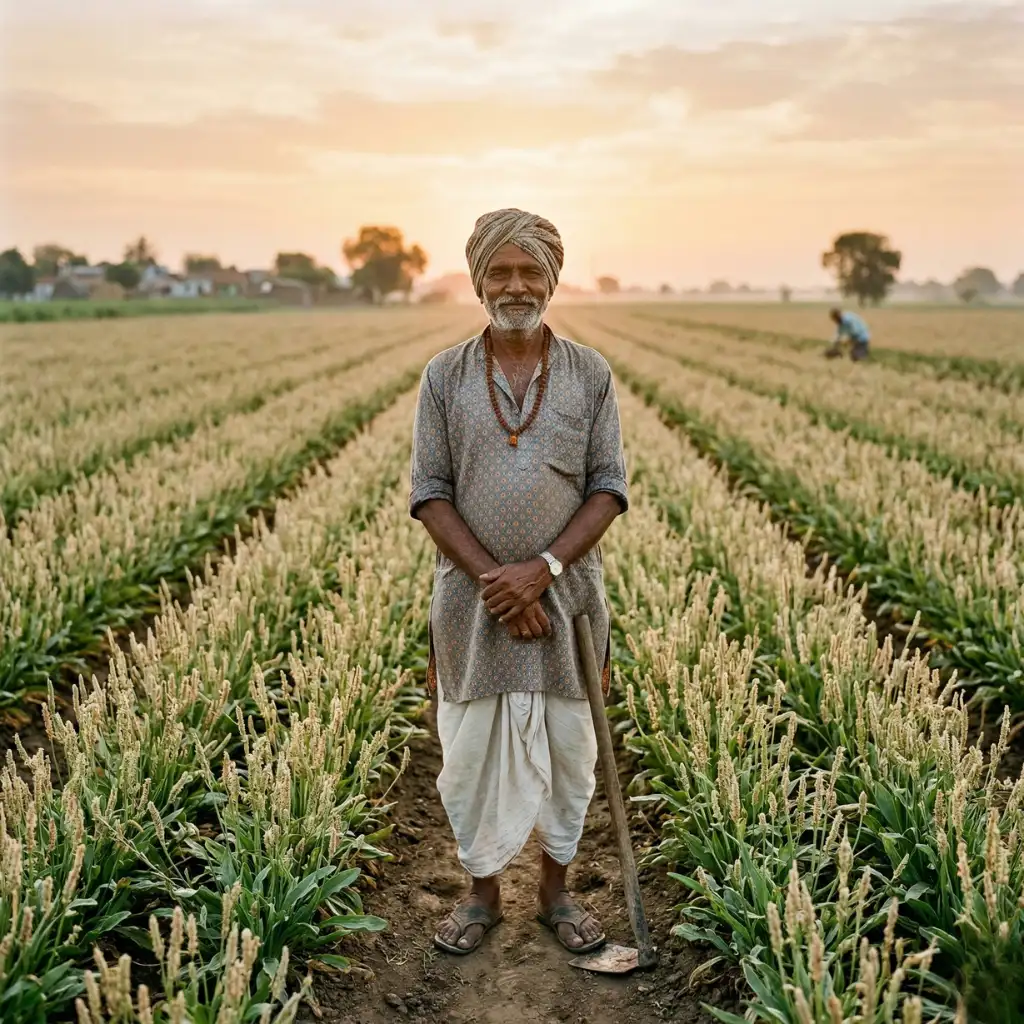
Most Buyers Have Never Thought About Where Their Psyllium Actually Comes From. Maybe They Should.
When a supplement brand in Moscow or a pharmaceutical company in Toronto buys psyllium husk, the transaction usually begins and ends with a supplier quotation and a Certificate of Analysis. The product arrives in bags. The paperwork checks out. Production runs. Nobody asks too many questions about what happened before the bags arrived at the warehouse.
That is understandable. Supply chains are complicated and buyers have a lot to manage. But we have found over the years that the buyers who take the time to understand where their psyllium comes from, how it is grown, how it is processed, and what actually happens between harvest and export, tend to make better sourcing decisions. They ask smarter questions. They spot the things in a supplier proposal that deserve more scrutiny. And they build supply relationships that hold up over time rather than unravelling after the third shipment.
So here is the honest version of the psyllium husk supply chain, from a farm in Gujarat to a shelf somewhere in the world. We will tell you what actually happens at each stage, why it matters for quality, and where the common points of failure are. We will also be straight about how Prime Psyllium fits into this picture.
1. It Starts With the Soil in North Gujarat
Psyllium, the plant whose seed husk becomes psyllium husk, has a name in botanical Latin that is Plantago ovata. It grows as an annual herb that reaches about 45 centimetres in height, with narrow leaves and a cluster of small white flowers that eventually produce the seeds from which the husk is separated. The seeds themselves look a little like flattened rice grains, pale and smooth. The husk is the thin mucilaginous layer surrounding each seed.
The plant has a particular relationship with the climate of North Gujarat and Southern Rajasthan. It needs cool, dry winters to establish itself and develop properly, followed by a warm, dry period as it matures and the seeds form. Too much humidity during the flowering and seed setting phase reduces husk quality and increases the risk of mould. Too much rain at harvest damages the seeds before they can be collected. The narrow window of conditions that produces premium psyllium husk reliably exists in very few places in the world, and the Palanpur to Unjha corridor of Gujarat is one of the most consistent of them.
Farmers in this region have been growing psyllium for generations. The knowledge of how to read the weather, when to sow, and when to harvest is embedded in the farming communities here in a way that cannot be replicated by setting up a psyllium farm somewhere else and following an instruction manual. The crop is planted around October and November and harvested between February and March. A good harvest year produces seeds with high husk content and strong mucilage properties. A difficult year, where rain or temperature variance disrupts the growing cycle, can affect the quality of the national crop across the board.
This is why the price of psyllium husk varies from year to year in a way that some buyers find surprising. It is an agricultural product with an agricultural product’s relationship to the weather. Buyers who understand this plan accordingly. Buyers who treat psyllium like a manufactured commodity with a fixed price sometimes get caught out when a difficult harvest year pushes prices up sharply.
2. What Happens at the Processing Facility
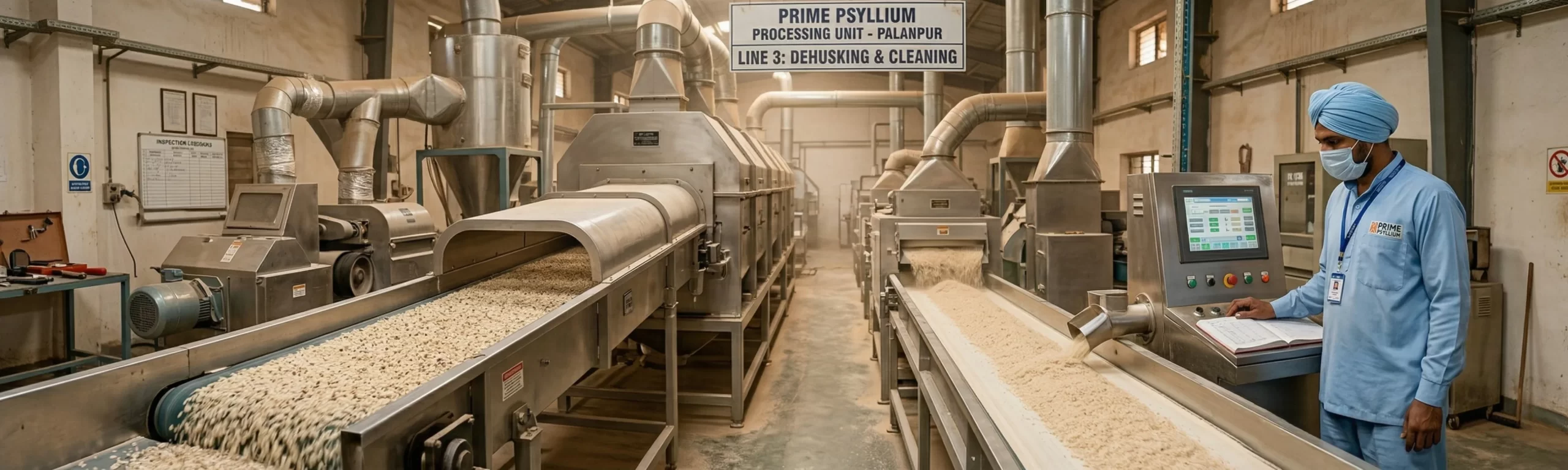
After harvest, the psyllium seeds arrive at processing facilities in the Palanpur region. What happens next determines the quality grade of the finished product more than almost anything else in the supply chain.
The first stage is cleaning. Raw psyllium seeds contain dust, plant fragments, and other agricultural material that needs to be removed before processing. The quality of the cleaning at this stage has a direct effect on the purity of the finished husk. A facility with well maintained cleaning equipment and rigorous process controls will consistently produce cleaner material than one where the cleaning machinery is outdated or poorly calibrated.
After cleaning, the seeds go through dehusking equipment that separates the outer husk from the inner seed. The efficiency and gentleness of this separation process affects how much intact husk is recovered versus how much is damaged or broken into fine particles. A higher proportion of intact husk generally means a higher swelling factor in the finished product, which is one of the key quality parameters for pharmaceutical and supplement grade psyllium.
The separated husk is then graded and classified by purity. This is where the 99%, 98%, 95% distinctions are established. Higher grades require more precise separation and more rigorous cleaning to remove the lower purity fractions. The final product is then tested against the specification, packed into HDPE woven bags with polyethylene inner liners to protect against moisture, and prepared for export.
At Prime Psyllium we run this process in our Palanpur facility, with in-house laboratory testing on every batch before the product is released for sale. Our quality team tests swelling factor, moisture content, ash content, microbiology, and heavy metals. Results that fall outside our internal specification do not ship. We would rather take the loss on a rejected batch than send a customer a product that does not meet their requirements.
3. The Export Documentation That Determines Whether Your Shipment Clears Customs
A clean, well-processed batch of psyllium husk sitting in a warehouse in Palanpur is only valuable once it has cleared customs at its destination. The document set that travels with every psyllium shipment is what makes that possible, and errors in that documentation are one of the most common and most avoidable causes of supply chain problems in this industry.
The core documents for a psyllium husk export shipment are the Commercial Invoice, the Packing List, the Certificate of Origin, the Phytosanitary Certificate issued by India’s Plant Quarantine authority, the Certificate of Analysis, and the MSDS or Safety Data Sheet. For pharmaceutical grade shipments to the USA, FDA Prior Notice is also required. For South Korea, certain product description fields must match Korean customs nomenclature. For Russia, specific regulatory compliance documentation may be needed depending on the end use classification. For Brazil, ANVISA-related ingredient documentation supports the importer’s compliance process.
Every destination country has its own customs requirements and its own tolerance for documentation errors. Russia in our experience has a very low tolerance. A single field error on the Certificate of Origin can delay a shipment significantly. US customs processes are smoother for well documented shipments but the FDA import alert system means that a supplier with a history of quality or documentation problems faces heightened scrutiny on future shipments from the same facility.
The exporters who handle this well are the ones who treat documentation as a core competency rather than an afterthought. At Prime Psyllium our export team prepares a destination specific document set for every shipment. We do not use a generic template and hope it passes. We have a checklist for each country we regularly export to, and every document is reviewed against that checklist before the shipment leaves.
4. Why Knowing Your Supplier’s Origin Story Matters
Ingredient sourcing transparency has become a genuine purchase driver in the supplement and health food industries in the USA, Canada, and increasingly in Russia and Brazil. Consumers want to know where their ingredients come from. Regulators in the US and Canada are moving toward greater traceability requirements. Retailers are asking supplement brands for more information about their supply chain as part of supplier qualification.
For buyers of psyllium husk, this means that working with a supplier who can give you a clear, honest account of where their product comes from has practical commercial value beyond the warm feeling of knowing you are buying responsibly. It means you can answer your customers’ questions. It means you can satisfy your retailer’s supply chain audit requirements. It means you have something real and specific to put on a label or website when you say your psyllium is sourced from Gujarat, India.
Prime Psyllium was founded in 2018 but our family’s involvement in the psyllium trade dates back to 1995. We source our raw seeds directly from farmers in the Palanpur region. We can tell you which growing season’s crop is in a given batch. We can tell you how it was cleaned, what grade it was tested at, and what the test results showed. That is the kind of origin transparency that we think responsible buyers deserve from their suppliers.
5. What This Means for Buyers in Russia, USA, Canada and Brazil
Understanding the psyllium supply chain makes you a better buyer. You know what questions to ask. You understand why price varies across seasons. You know which stages of the supply chain are most likely to introduce quality variation. And you know what a supplier who has genuinely invested in getting this right looks like compared to one who is just relabelling product they bought from someone else.
If you are sourcing psyllium for any of the markets we serve, we would be happy to walk you through our production process in detail, share our quality documentation, and give you a clear picture of exactly what you would be buying and where it came from. That conversation is available to any serious buyer at no cost and no commitment. We think it is the right way to start a supply relationship and we have found that buyers who appreciate transparency tend to become the partners we work with longest.
Ready to Source the World’s Finest Psyllium?
Quality • Purity • Global Reach
www.primepsyllium.com | [email protected]
Prime Psyllium — India’s Trusted Psyllium Manufacturer and Global Exporter
