


Psyllium Husk Grades: What the Numbers Actually Mean and Which One Your Business Needs
April 7, 2026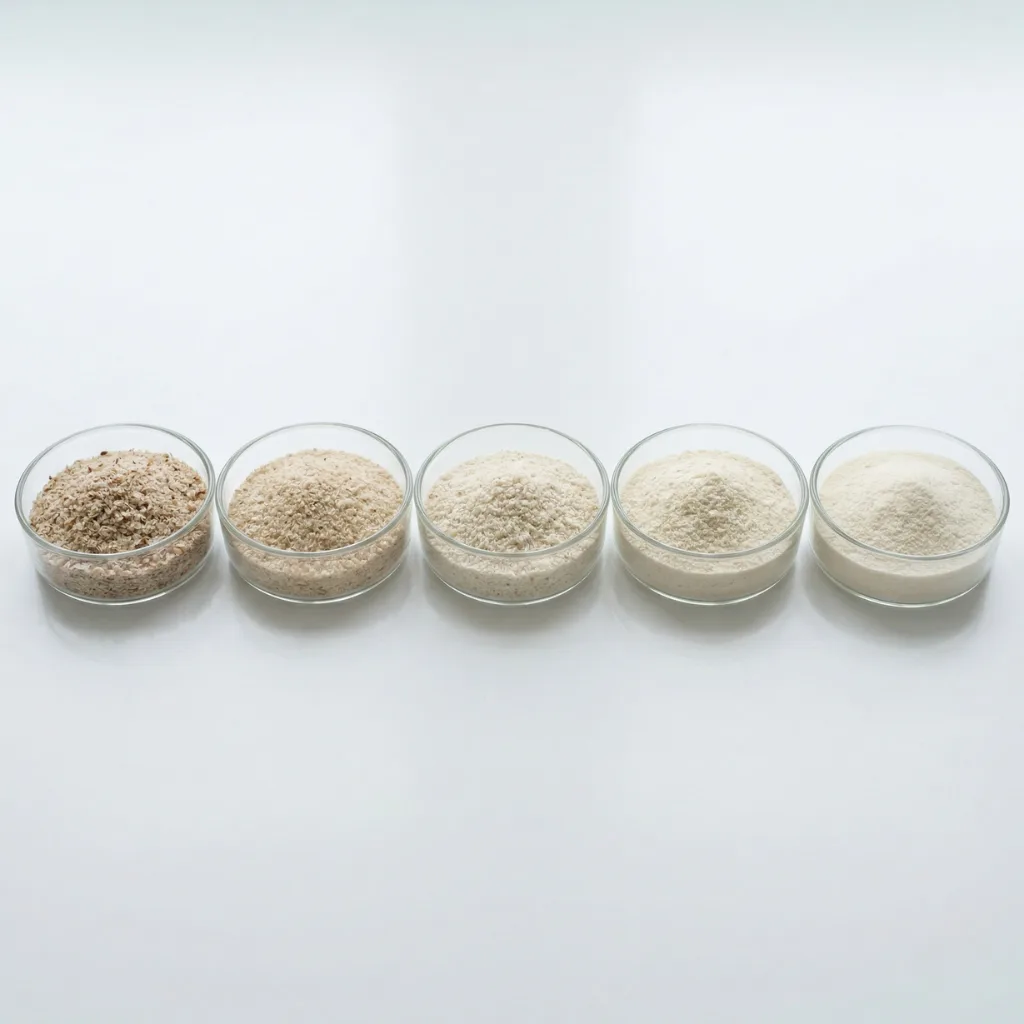
The Grade You Choose Affects Your Label, Your Margins, and Your Regulatory Standing.
Psyllium husk is not one product. It is a category of products, and within that category there are real, meaningful differences in purity, application suitability, and regulatory standing that most supplier websites do not explain clearly.
Buyers who treat psyllium as a commodity where price is the only variable tend to find out the hard way that grade selection matters. The day your formulation produces inconsistent results, or the day a regulatory inspector questions whether your raw ingredient purity actually supports the health claim on your packaging, is not the day you want to be learning about the difference between 98% and 95%.
This guide covers psyllium husk purity grades in plain language without the marketing filter. What each grade means, how it is measured, which applications it suits, and what buyers in the USA, Canada, and South Korea most commonly use in practice. We will also be straight about where our own products sit within this picture.
1. What the Purity Percentage Actually Refers To
The purity number on a psyllium husk specification tells you the proportion of the material that is clean, processed psyllium husk, as opposed to seed coat fragments, fine dust, and other plant material that comes through during the dehusking process. Higher purity means cleaner separation, higher mucilage content per gram, and better performance in applications where the fiber’s functional properties are doing the work.
Purity is measured through a standardised set of tests. For pharmaceutical grade psyllium sold into the US and South Korean markets, the relevant standard is USP 29, the United States Pharmacopoeia monograph for Plantago husk, which defines specific requirements for swelling factor, moisture, ash content, and microbiological safety. For UK and European pharmaceutical buyers, BP (British Pharmacopoeia) applies. For food grade psyllium, FSSAI standards in India and the relevant national food safety standards in the destination country govern testing.
A full quality analysis covers the swelling factor, which tells you how much the husk expands in water and indicates mucilage content. It covers moisture content, which affects shelf life and product integrity. It covers ash and acid-insoluble ash, which indicate mineral and silica levels. It covers heavy metals including lead, arsenic, cadmium and mercury. And it covers microbiological parameters including Total Plate Count, Salmonella, E. coli, Yeast and Mould. Pesticide residue testing rounds out the profile.
When a supplier quotes you a 99% purity grade, they should be able to show you a Certificate of Analysis that references the specific testing standard, names the laboratory that ran the tests, and provides results for all of those parameters. A purity number on its own, without the supporting test data, tells you almost nothing of practical value.
2. Each Grade Explained in Plain Terms
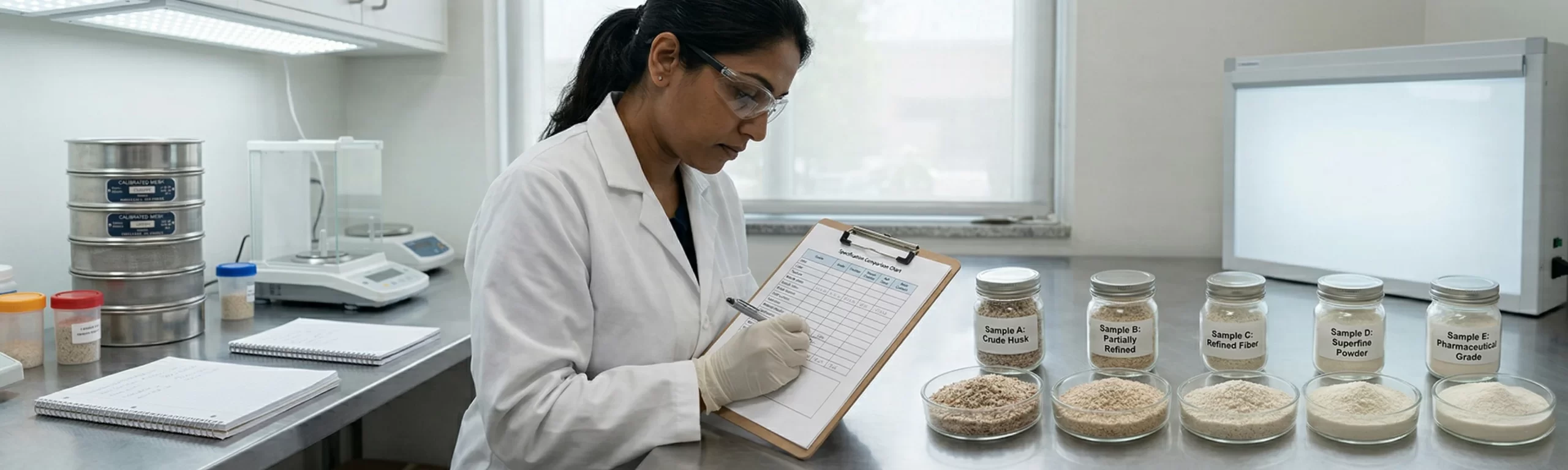
99% Pharmaceutical Grade
This is the highest commercially available grade and it is what regulated pharmaceutical products in the USA and South Korea require. Testing against USP 29 or BP monograph standards. Swelling factor typically 10 or above per USP specification. Strict limits on heavy metals, pesticide residues, and microbiological contamination. This grade is required for OTC laxative products in the US market, for products carrying FDA-approved psyllium health claims, and for pharmaceutical formulations regulated by South Korea’s MFDS.
It is the most expensive grade for a real reason. Producing 99% USP-compliant psyllium consistently at commercial scale requires proper processing equipment, rigorous quality control, and regular independent testing. When you see this grade offered at prices that seem unusually close to food-grade pricing, that is a signal worth taking seriously.
98% High Grade
This is the grade that the majority of premium dietary supplement brands in the USA and South Korea source at. It meets the quality requirements for supplement-grade applications in both markets, it is well priced relative to 99%, and it is available in consistent supply from established manufacturers. For most supplement brand applications outside the regulated pharmaceutical channel, 98% is the practical sweet spot of quality and value.
95% Food Grade Plus
The most widely used grade in food manufacturing globally. Right for gluten-free baking, fiber fortification in cereals and bars, functional food inclusions, and the majority of food processing applications where psyllium is working as a binding or thickening agent rather than as a primary health ingredient. Many Brazilian supplement brands also source at 95% for products where the positioning does not require pharmaceutical-grade purity claims.
85% to 90% Standard Grade
Cost-efficient and appropriate for applications where premium positioning is not a factor: animal feed formulations, industrial food processing, private label products at entry price points. Buyers in the USA and South Korea formulating regulated health products should not be using this grade regardless of how the pricing looks. For Brazilian and Russian buyers sourcing for industrial food production, this grade is commercially suitable.
70% to 80% Industrial Grade
The lowest traded grade, primarily used in industrial applications and specialty animal nutrition. Most supplement and food brands reading this will not need to consider it.
3. What Buyers in the USA, Canada and South Korea Actually Order
Based on our experience supplying all three markets, here is what the patterns actually look like in practice.
In the United States the split runs roughly between 99% for pharmaceutical and clinical-grade applications on one side and 98% for the broad mainstream supplement market on the other. The US supplement industry is large enough that most brands hold 98% as their baseline and step up to 99% only for regulated pharmaceutical products or premium positioning that specifically calls for it. Food manufacturers buying for gluten-free baking or fiber fortification work at 95%.
Canada’s market mirrors the US pattern fairly closely. Health Canada’s NHP framework applies meaningful regulatory oversight to supplement ingredients, which means Canadian buyers tend to prefer 98% as their default rather than accepting any ambiguity with lower grades. The Canadian gluten-free food sector is proportionally significant and is a substantial user of 95% food-grade psyllium powder.
South Korea is the most specification-conscious market we supply. Korean supplement buyers are diligent about documentation, they tend to require 98% or above as their baseline, and internal quality standards at Korean companies often go beyond the minimum regulatory requirement. Korean food companies using psyllium in functional food applications usually source at 95% or 98% depending on the product tier and the label claims they are making.
4. Managing Costs Without Choosing the Wrong Grade
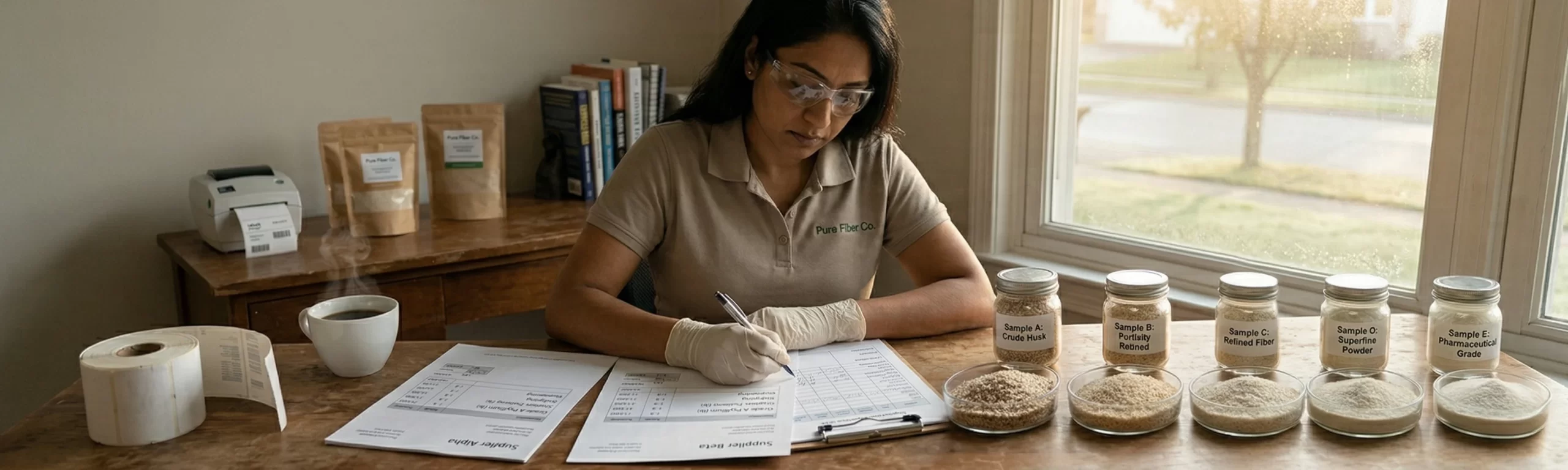
One of the most common sourcing mistakes we see from buyers managing tight margins is purchasing a lower grade than their application genuinely requires. The per kilogram saving looks real on a procurement spreadsheet. But if your product carries premium supplement positioning and your label claims are built on a certain quality standard, sourcing at 90% to save costs is a decision that will create a problem somewhere down the line.
There are better ways to manage psyllium sourcing costs without compromising on grade. Consolidating orders into larger volumes, even if it means holding more stock, almost always produces better pricing from a reliable manufacturer than repeated spot purchases at smaller quantities. Establishing a supply agreement for a defined annual volume gives the supplier a reason to sharpen their pricing because they have predictable demand to plan around. And talking openly with your supplier about which grade your application genuinely requires can sometimes reveal that you have been over-specifying. If 98% will fully satisfy your regulatory and formulation needs, there is no commercial reason to pay for 99%.
We have those conversations with buyers at Prime Psyllium because we think they are important. A buyer who sources the right grade at the right price, on a sustainable supply relationship, is a buyer who stays with us. That is better for both sides than a transaction that works once and then creates complications.
5. How to Request Samples and Start a Grade Evaluation
If you are at the point of deciding which grade to source and you want to test before committing, we can support that process directly. We send samples of two or three grades that are relevant to your application, each with a Certificate of Analysis, so you can test them in your own facility and make a decision based on actual performance rather than a specification on paper.
The process is simple. You reach out with your application details, your end market, and a sense of the regulatory environment you are working within. We recommend the grades that make sense. Samples go out within five business days. Most buyers complete their internal testing within two to three weeks and come back with a clear view.
From there we move to a commercial quotation, usually a trial order, and then a supply agreement if the relationship is working well on both sides. We are genuinely interested in finding buyers who need reliable psyllium and who value consistency and honest communication in a supply relationship. If that is you, it would be good to hear from you.
Ready to Source the World’s Finest Psyllium?
Quality • Purity • Global Reach
www.primepsyllium.com | [email protected]
Prime Psyllium — India’s Trusted Psyllium Manufacturer and Global Exporter
